By admin
The Road to S/4HANA

Published by Liquid Peak Consulting | SAP Strategy & Business Transformation
Why S/4HANA Matters
Migrating to SAP S/4HANA is a strategic move for many enterprises—but it’s also a complex one. As businesses transition from ECC and legacy platforms, the promise is clear: real-time processing, simplified architecture, embedded analytics, and a modern user experience.
But for those of us on the front lines of delivery, the reality of the journey often looks very different.
At Liquid Peak, we’ve worked on global S/4HANA programs across multiple industries and regions. In this article, we’re sharing key lessons learned—what works, what doesn’t, and what to do about it.
Common Challenges on the Road to S/4HANA
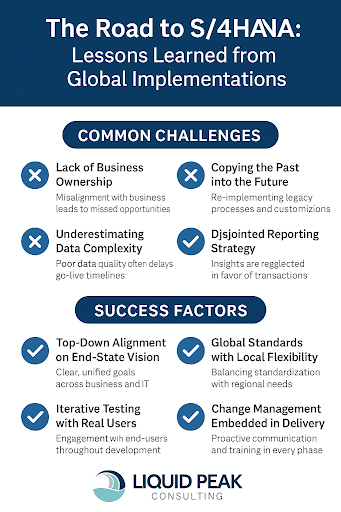
1. Lack of Business Ownership
Many projects begin as IT-led initiatives. While IT is essential for delivery, business ownership is what drives value. Without early engagement from finance, supply chain, or operations, critical process changes are either missed or delayed until post-go-live.
TIP: Engage business leaders as co-owners from day one. Make sure they are not just attending work shops but driving decisions.
2. Copying the Past into the Future
A common trap: rebuilding what you had in ECC—just in S/4HANA. This includes legacy reports, outdated processes, and customizations that no longer serve a purpose. The result? Higher costs, missed innovation, and zero transformation.
TIP: Use the migration as a reset. Challenge every legacy process. Ask, “Does this add value in a real-time, digital business environment?”
3. Underestimating Data Complexity
Data issues are one of the biggest causes of project delays. From duplicate records and missing fields to inconsistent master data across systems, poor data leads to poor outcomes—even in a state-of-the-art platform like S/4HANA.
TIP: Start data cleansing early. Appoint dedicated data owners. And don’t assume the business “will get to it”. Data quality should be treated as a go-live gate.
4. Disjointed Reporting Strategy
Many S/4HANA projects focus on transactions, not insights. Reporting is often left to the end or treated as “phase two.” But this leads to frustration post go-live when users can’t get the information they need.
TIP: Define your reporting strategy upfront. Integrate SAP Analytics Cloud, Business Data Cloud (Datasphere) and other tools into your delivery model – not as afterthoughts, but as enablers of decision making from day one.
Success Factors That Make the Difference
✔️ Top-Down Alignment on End-State Vision
Programs that succeed have clear alignment between business, IT, and executive sponsors on what success looks like. That vision is referenced regularly—not just at the kickoff meeting.
✔️ Global Standards with Local Flexibility
In global rollouts, standardization is key—but not at the expense of regional needs. The most effective S/4HANA programs establish core processes globally and define a controlled framework for local variation.
✔️ Iterative Testing with Real Users
Avoid the trap of testing purely with internal IT or offshore teams. Use business users in every test cycle. It improves adoption, highlights usability issues early, and builds internal champions.
✔️ Change Management Embedded in Delivery
Change isn’t a slide deck at the end—it’s the heartbeat of the program. Programs that succeed embed change agents, user training, and communication planning into every stage of delivery.
Final Thoughts: S/4HANA Is a Journey, Not a Lift-and-Shift
The companies that get the most out of S/4HANA treat it as a business transformation, not an IT upgrade.
It’s an opportunity to:
- Rethink how work gets done
- Streamline and automate
- Improve visibility across operations
- Enable real-time, data-driven decisions
At Liquid Peak, we partner with businesses not just to implement—but to redefine how SAP drives value in the modern enterprise.
Ready to Move to S/4HANA with Purpose?
If your team is considering or already on the path to S/4HANA, let’s talk. We’ll help you avoid the pitfalls, challenge the status quo, and deliver a roadmap aligned to real business impact.